
Digify AI
Typically replies instantly
This AI bot can make mistakes. Please double-check information.
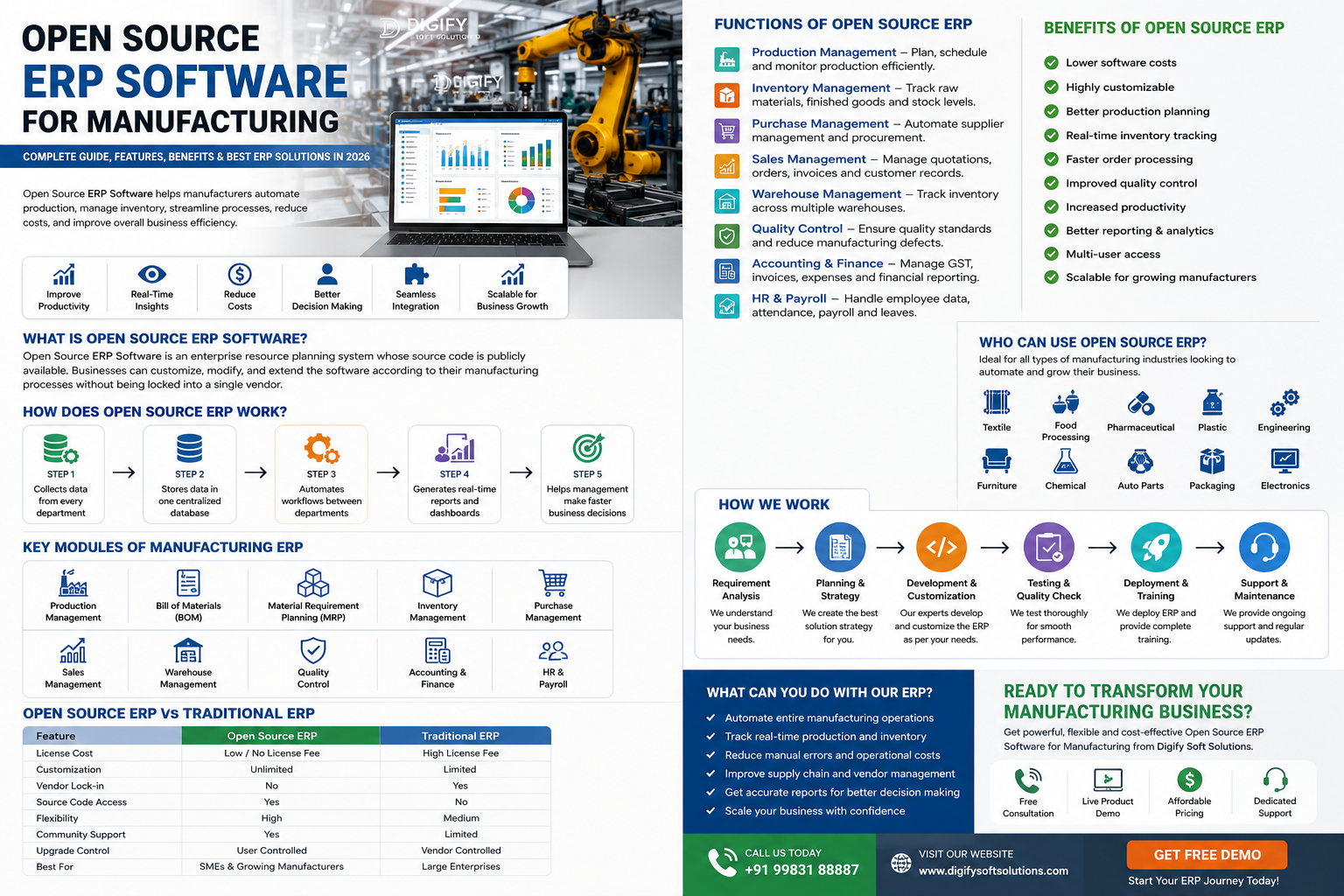
The manufacturing industry is becoming increasingly competitive, requiring businesses to improve efficiency, reduce costs, and streamline operations. Manual processes, disconnected software, and spreadsheets often lead to production delays, inventory inaccuracies, and poor decision-making. This is where Open Source ERP Software for Manufacturing becomes a game changer.
An open source ERP system provides manufacturers with the flexibility to customize workflows, automate processes, and integrate all business operations into a single platform. Whether you're a small factory, a mid-sized manufacturer, or a growing enterprise, implementing an ERP solution helps improve productivity while keeping operational costs under control.
AtDigify Soft Solutions, we provide advanced manufacturing ERP solutions that help businesses automate production planning, inventory management, procurement, finance, sales, and quality control.
Open Source ERP Software is an enterprise resource planning system where the source code is publicly available. Businesses can modify, customize, and extend the software according to their operational requirements.
Unlike traditional ERP software, open source ERP gives manufacturers greater flexibility, better control over customization, and lower licensing costs.
The software integrates multiple departments into one centralized system, enabling seamless communication and real-time data sharing across the organization.
Manufacturers often face challenges such as:
An ERP system eliminates these issues by automating workflows and providing real-time insights into every aspect of the manufacturing process.
Open source ERP integrates all manufacturing departments through a centralized database.
The ERP collects information from production, inventory, purchasing, sales, finance, and warehouse operations.
All information is stored in one secure database, eliminating duplicate records.
Routine processes such as purchase approvals, production scheduling, inventory updates, and invoicing are automated.
Management can monitor production status, inventory levels, sales performance, and financial reports in real time.
Interactive dashboards provide insights for better forecasting and strategic decision-making.
Plan and schedule manufacturing operations based on demand, machine availability, and workforce capacity.
Manage product structures, raw materials, and manufacturing components with complete accuracy.
Automatically calculate material requirements to avoid production delays.
Track raw materials, work-in-progress inventory, and finished goods across multiple warehouses.
Automate supplier management, purchase orders, approvals, and procurement tracking.
Manage quotations, customer orders, invoicing, and payment tracking.
Optimize warehouse operations using barcode scanning, batch tracking, and stock movement monitoring.
Conduct quality inspections throughout the production cycle to maintain product standards.
Manage GST billing, ledgers, receivables, payables, bank reconciliation, and financial reporting.
Track employee attendance, payroll, leave management, and workforce productivity.
Automation minimizes manual work and reduces administrative expenses.
Real-time stock updates prevent overstocking and stock shortages.
Automated scheduling ensures efficient resource utilization and timely production.
Improved order management leads to faster deliveries and higher customer satisfaction.
Integrated quality management reduces defects and ensures consistent product quality.
Interactive dashboards provide accurate reports for better business decisions.
Businesses can customize workflows, reports, and modules according to their manufacturing processes.
The ERP grows with your business and supports expanding production facilities.
| Feature | Open Source ERP | Proprietary ERP |
|---|---|---|
| Initial Cost | Lower | Higher |
| License Fees | Usually None | Recurring |
| Customization | Extensive | Limited |
| Vendor Lock-In | No | Yes |
| Source Code Access | Yes | No |
| Flexibility | High | Moderate |
| Community Support | Available | Vendor-Based |
| Best Fit | SMEs & Growing Manufacturers | Large Enterprises |
Open source ERP is suitable for:
Before selecting an ERP solution, consider:
Digify Soft Solutions specializes in manufacturing ERP software tailored to the needs of Indian manufacturers. Our ERP solutions help businesses automate operations, improve efficiency, and make informed decisions.
Many open source ERP platforms do not require license fees, but implementation, hosting, customization, and support typically involve costs.
Yes. Small and medium-sized manufacturers can benefit from lower costs, flexibility, and scalability.
It can be very secure when properly configured, updated regularly, and hosted using secure infrastructure.
Implementation time depends on the number of modules, business complexity, and customization requirements. It can range from a few weeks to several months.
Yes. Most manufacturing ERP solutions support barcode and QR code integration for inventory and warehouse management.
Open Source ERP Software for Manufacturing empowers businesses to streamline operations, reduce costs, and improve productivity through automation and centralized data management. By integrating production, inventory, finance, sales, procurement, and quality control into one platform, manufacturers gain complete visibility and control over their operations.
If you're looking for a scalable and customizable ERP solution, Digify Soft Solutions offers industry-focused manufacturing ERP software designed to meet the needs of modern businesses.
Take control of your production, inventory, sales, and operations with a powerful Manufacturing ERP solution from Digify Soft Solutions.
Get Started Today:
Contact Digify Soft Solutions today and discover how the right ERP can help your manufacturing business grow faster, operate smarter, and stay ahead of the competition.
In 2026, the landscape for Open Source ERP in manufacturing has shifted from "basic alternatives" to strategic, enterprise-grade solutions. Modern manufacturers are increasingly leveraging these platforms to avoid vendor lock-in, eliminate per-user licensing fees, and gain granular control over their digital infrastructure.
| Software | Best For | Manufacturing Strengths |
| ERPNext | SMEs & Growing Manufacturers | Complete "out-of-the-box" manufacturing suite (BOM, MRP, Work Orders, Subcontracting). |
| Odoo | Mid-market & Modular Needs | Highly modular; massive ecosystem of apps; user-friendly interface. |
| Apache OFBiz | Large/Complex Customizations | Robust, highly extensible framework for complex, niche manufacturing processes. |
| iDempiere | Enterprise Scalability | Plugin-based, highly stable, and capable of managing complex supply chains. |
| Tryton | Technical/Dev-Centric Teams | Modular, secure architecture; ideal for companies requiring deep data integrity. |
When vetting these systems, ensure the solution supports the following 2026-standard requirements:
Production Management: Advanced Bill of Materials (BOM) management, including multi-level and "Phantom" BOMs.
Capacity Planning: Real-time visibility into workstation workloads to prevent bottlenecks.
Subcontracting: Native support for managing external job work, including material transfers and GST compliance (if operating in India).
Quality Assurance: Integrated non-conformance reporting, inspection plans, and quality analytics.
Traceability: End-to-end tracking of serial numbers and batches from raw material procurement to finished goods.
Cost Control: By removing per-user licensing fees, you can reallocate capital expenditure toward custom process optimization and hardware.
Process Freedom: Unlike proprietary systems that force you to adapt your workflows to their "standard," open-source code allows you to modify the software to fit your unique production floor.
Independence: You own your data and code. You are free to switch between service partners without the threat of system obsolescence.
Expertise Requirement: "Open source" does not mean "maintenance-free."
Hidden Costs: While the software is "free," budget for implementation, hosting, data migration, and custom development.
Governance: Increased flexibility requires strict project governance to prevent "feature creep" or overly complex, unmaintainable customizations.
Define Requirements: Document your specific manufacturing mode (e.g., Job Shop, Make-to-Order, Discrete).
Shortlist: Pick 2–3 platforms that align with your technical team's proficiency (e.g., Python/Frappe for ERPNext vs. Java for iDempiere).
Partner Vetting: For enterprise deployments, work with a certified partner.
Phased Rollout: Start with core modules (Inventory, Procurement, Basic MRP) before moving to advanced features like Shop Floor Control or IoT machine integration.
